

How To Repair Torn Ligaments In Hand
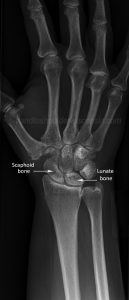
Figure 1: Scaphoid and lunate bone
The team of orthopedic doctors and therapists at Hand to Shoulder Middle are here to diagnose and treat mitt, finger, wrist, elbow, forearm, and shoulder ligament injuries. Contact Hand to Shoulder Eye of Wisconsin in Appleton or Green Bay, WI today to learn more about how our orthopedic specialists tin can help you.
Ligaments are tough, gristly tissue that connects one end of a bone to another. They add stability and support to the articulation, maximizing strength and preventing excess movement. Ligaments are found throughout the torso and are often injured when they are stretched, torn or ruptured acquired by direct or indirect trauma. Ligament injuries are adequately common especially in the hand due to general exposure and overuse in solar day to day activities. Ligament injuries usually consist of fractional ligament tears often referred to as a sprain. Areas nearly affected by a torn ligament include the finger joints, wrist, ankle, and articulatio genus. Ligament injuries tin occur at any age.
Wrist injuries involving ligaments happen when the wrist is bent backwards and ligaments and tendons are stretched. Such injuries typically occur from a fall on an outstretched paw, twisting injury or sporting activity. The most usually injured wrist ligaments are the scapholunate, located between the scaphoid bone and the lunate bone (Fig. 1) and the TFCC (triangular fibrocartilage complex).
Symptoms of a Ligament Injury
Following a ligament injury, symptoms often include: bruising, swelling, local pain, and limited movement (stiffness) of the injured articulation. In shoulder ligament injuries, individuals may report difficulty in the inability to sleep on the affected shoulder.
At Hand to Shoulder Center of Wisconsin, our orthopedic surgeons treat all upper extremity injuries, including ligament injuries affecting the finger, hand, wrist, elbow, and shoulder.
Diagnosis and Treatment
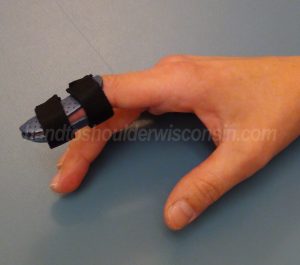
Effigy 2: Mallet finger splint
In diagnosing ligament damage, our subspecialty-trained orthopedic surgeons conduct a thorough examination. Review of medical history is discussed along with conducting a physical and visual evaluation. Swelling and points of tenderness along with the stability of the affected joints are explored. Upper extremity movements and the limited use will help to confirm the level of the injury and pinpoint the ligaments involved. X-rays are typically taken to confirm no broken basic are present. Depending on the severity of the ligament hurting, additional tests may be ordered to help diagnose the extent of the injury or to dominion out other conditions and diseases. Such tests include a computed tomography (CT) scan or a Magnetic Resonance Imaging (MRI).
Ligament injury handling varies depending on the severity of the torn ligament(south). In torn hand ligament cases involving finger injuries, such as a mallet finger, conservative handling involves the use of a finger splint (Fig. 2) to keep the tip straight at all times for the finger ligament to heal.
In shoulder cases involving torn shoulder ligaments without a fracture or dislocation, the severity of the ligament harm will determine the protocol our orthopedic surgeon applies. Mild to moderate tears often may involve joint instability forth with shoulder ligament pain and swelling. In more severe cases when the ligaments and/or tendons are ruptured completely, shoulder pain treatment may involve surgical repair. Whether balmy or severe, physical or occupational therapy is often needed to address the pain, muscle guarding and range of motion limitations that tin can occur equally a issue of the injury.
Upper arm and shoulder ligaments can as well exist affected by degeneration of the muscle and tendon fibers. This typically will occur in older individuals who report no known trauma. Poor posture, repeatedly lifting heavy objects overhead, or poor physical condition may likewise play a role in shoulder pain causation.
Rehabilitation
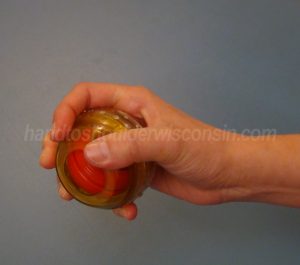
Effigy 3: Muscle reflex grooming following a wrist injury
The goal of rehabilitation is to decrease pain and inflammation while restoring total role to the afflicted joint. Depending on the type of direction (operative or non-operative), a physical or occupational therapist will perform hands-on techniques to assistance in restoring full range of motion, normal articulation part along with increasing strength. Modalities such every bit heat or ice are oft used to help command pain, facilitate motion and control swelling.
Depending on the level of injury, early rehabilitation treatment protocols often include a home exercise program to encourage range of motion and flexibility (Fig. 3). The duration of recovery time will vary depending on the severity of the condition and the patient'southward willingness to acquit home exercises. Typically, in mild ligament injuries, normal activities tin begin within iii to 6 weeks. In more astringent cases, recovery time may take six to viii weeks of occupational or physical therapy to optimize range of motility and strengthen the repaired tissue and joint. The duration of treatment is related to the degree of injury, healing response and any complications.
Full Medical Disclaimer
"The materials on this website are not intended or implied to be a substitute for professional medical advice, diagnosis or treatment. All content, including simply not express to, text, graphics, images and data contained on or available through this website have been prepared for informational purposes merely. This data should not be interpreted as a recommendation for a specific treatment plan. Y'all should not human activity or rely upon any medical information in this website without a physician's communication."
Source: https://handtoshoulderwisconsin.com/our-specialties/hand/ligament-injury/
0 Response to "How To Repair Torn Ligaments In Hand"
Post a Comment